



Atmospheric stability describes how air moves and mixes within the atmospheric boundary layer. It directly affects wind shear, turbulence intensity, wake recovery, and ultimately the accuracy of wind farm energy yield assessments.
In the fast-changing world of wind energy, understanding atmospheric stability is key to accurate energy yield assessments. Recent studies show that variations in stability can greatly influence performance predictions. By integrating stability parameters, wind resource engineers align with industry standards and improve their energy estimates. Ignoring these dynamics can introduce biases that affect investment decisions and project viability. Thus, incorporating atmospheric stability into energy assessments is crucial for optimizing wind energy production.
The inclusion of atmospheric stability parameters (e.g. Monin–Obukhov length) in Vortex time series enables wake models to move beyond neutral-atmosphere assumptions, reducing AEP bias and improving bankability of energy yield assessments, as demonstrated in a WindTech26 poster by InterContinental Energy.
The study confirms atmospheric stability as a first-order driver of wake losses and shows that neglecting it leads to systematic energy yield bias.
Vortex TIMES and Vortex SERIES include atmospheric stability indicators such as Richardson Number and Inverse Monin–Obukhov Length, allowing engineers to incorporate stability-aware assumptions directly into wind resource and wake modelling workflows.
Example rows from a time series file:
YYYYMMDD HHMM  M(m/s) D(deg)  T(C)  De(k/m3) PRE(hPa)      RiNumber  RH(%)   RMOL(1/m)
19991231 1800    1.6    169    9.4    1.06     862.7           2.25   62.6      0.5342
19991231 1900    1.4    187    9.1    1.06     862.4           4.93   60.9      0.8470
19991231 2000    1.6    171    9.0    1.07     862.2           2.07   58.4      0.3648
19991231 2100    2.7    155    9.1    1.06     861.9           0.90   52.9      0.2006
We provide both variables because RMOL is directly output by WRF, while RiNumber can be computed from wind and temperature levels from WRF.
Atmospheric stability describes the tendency of air parcels to move vertically in the atmosphere. It influences wind shear, turbulence intensity, momentum mixing, and ultimately wind turbine performance.
The Richardson Number compares two competing processes in the atmosphere:
In simple terms:
This makes the Richardson Number a useful indicator of the balance between thermal and mechanical effects in the atmospheric boundary layer.
RiNumber is computed using the bulk Richardson formulation described by Stull [Reference: An Introduction to Boundary Layer Meteorology]
Level definition around the requested height
This means Ri can be computed from two surrounding WRF levels (lower and upper, around the requested level), with temperature at the requested level in the denominator.
Potential temperature correction

Applied at each level:
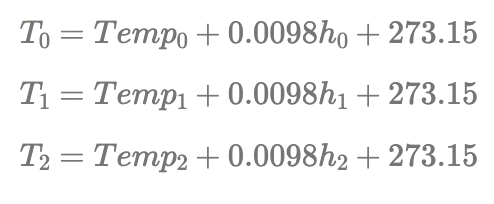
Bulk Richardson number used in Vortex
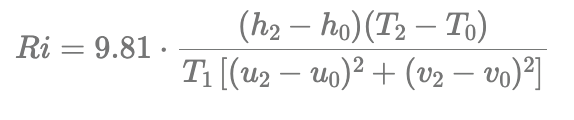
Note: if wind differences between upper and lower levels are very small, the denominator can become small and Ri can become very large.
The Monin-Obukhov Length (L) is one of the most widely used stability parameters in boundary-layer meteorology. It represents the height at which buoyancy forces become as important as mechanical turbulence production.
Because L can vary from a few metres to several kilometres, WRF outputs its inverse (1/L), reported in Vortex time series as RMOL:
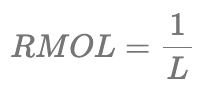
Large absolute values indicate increasingly unstable or stable conditions.
In Vortex, we use an empirical relationship between Ri and Monin Obukhov length:
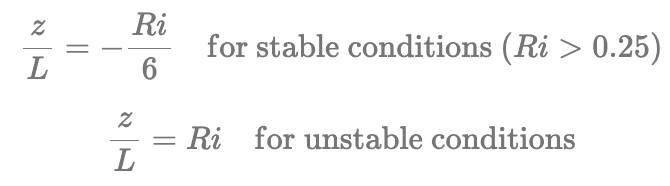
where z is the requested height above ground level and L is the Monin-Obukhov length.

For reporting purposes, Richardson Number values can be grouped into qualitative stability classes. These categories provide an intuitive way to summarize the atmospheric conditions experienced at a site over long periods.
While the exact thresholds vary slightly among studies, the classification below is commonly used in wind resource assessment and follows the Bulk Richardson Number approach implemented in Vortex SERIES.
| Class | Ri range |
|---|---|
| Very Unstable | Ri < -5 |
| Unstable | -5 < Ri < 0 |
| Neutral | 0 < Ri < 0.25 |
| Stable | 0.25 < Ri < 1 |
| Very Stable | 1 < Ri |
Because atmospheric stability directly influences wind shear, turbulence intensity, and wake recovery, accurately classifying stability conditions is a critical step in wind energy yield assessment. Incorporating stability information into wind resource and wake models helps reduce systematic bias and improves the reliability of AEP estimates.

Atmospheric stability describes how air mixes within the atmospheric boundary layer due to the balance between mechanical turbulence and thermal buoyancy. It influences wind shear, turbulence intensity, wake recovery, and ultimately the accuracy of wind energy yield assessments.
Atmospheric stability directly affects wake losses and wind farm performance. Ignoring stability can introduce systematic bias in Annual Energy Production (AEP) estimates, particularly in large wind farms where wake interactions are significant.
The Monin–Obukhov Length (L) is a key atmospheric parameter used to classify stability conditions as stable, neutral, or unstable. It helps quantify the relative influence of thermal buoyancy and mechanical turbulence in the atmospheric boundary layer.

Modeled wind resource data for the wind industry.
At any site around the world. Onshore and offshore.