



When it comes to wind energy, one of the critical parameters is the reference wind speed, known as Vref. This value is pivotal in determining turbine classes according to the IEC 61400 standard. But what exactly does Vref mean, and why is it important? Let’s break it down!
The reference wind speed is defined as the 10-minute wind speed associated with a 50-year return period. Simply put, if you have a Vref of 45 m/s at your site, it implies that there’s a 2% chance of exceeding this wind speed in any given year. However, this doesn’t mean that such an event will happen exactly once every 50 years; wind events are statistically independent, much like rolling a die.
The return period, or recurrence interval, is a crucial concept in understanding extreme weather events. For example: 10 years: 10% annual probability of exceedance; 50 years: 2% annual probability of exceedance; 100 years: 1% annual probability of exceedance. This statistical framework helps assess risks associated with natural events, including extreme winds.
To estimate Vref , one common method is the Gumbel fit, a statistical approach that models extreme values. The Gumbel distribution has two key parameters: location (μ) and scale (β). This distribution is particularly effective for predicting extreme wind speeds, allowing us to extrapolate Vref for different return periods.
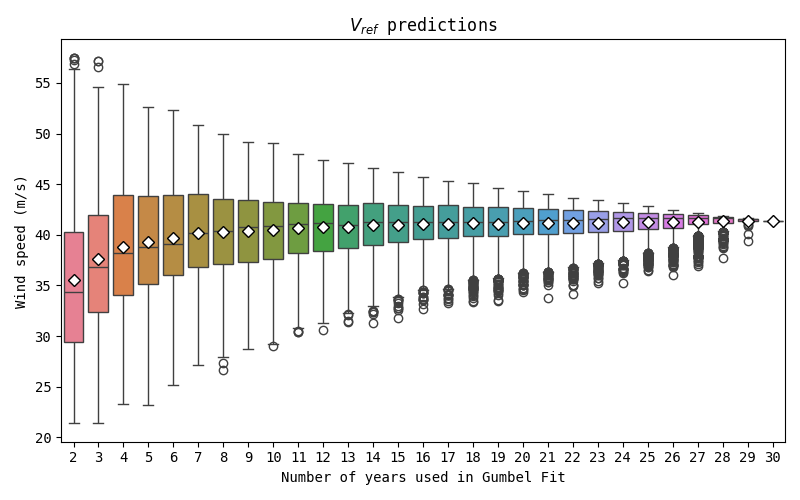
One of the most striking takeaways from recent studies is how sensitive Vref is to the amount of data used for its calculation. Short measurement records (3–5 years) can yield unreliable estimates, potentially leading to significant variability. For instance: 5 years of data: Wide range of estimates, from 20 m/s to 55 m/s. 15 years of data: Tighter estimates but still variability. 30 years of data: A single, reliable estimate with minimal spread.
This variability underscores the importance of using as much data as possible to obtain a more accurate estimate of Vref.
In the wind energy sector, understanding and estimating Vref is vital for turbine design and risk assessment. This probabilistic estimate is influenced by data quality and sample size, making it essential to approach it with a statistical mindset. Next time you come across a Vref figure, consider the data behind it. How many years of data were used? What uncertainties might exist? By grasping these concepts, we can better navigate the complexities of wind energy and make informed decisions that harness the power of the wind more effectively.
To explore more details and insights, download the full document. It enhances your understanding of extreme wind estimates and their impact on wind energy projects!
A 50-year return period does not mean that an event occurs exactly once every 50 years. It means that the event has a 2% probability of being exceeded in any given year.
Vref is the reference wind speed associated with a 50-year return period and is a key parameter in wind turbine design. It represents an estimate of the extreme 10-minute mean wind speed that may occur at a site under rare but plausible conditions.
Vref is important because it is used to determine the structural loads that a wind turbine may experience during its lifetime. The value helps engineers assess whether a turbine is suitable for a specific location and plays a central role in the IEC wind turbine classification system (e.g., Class I, II, or III turbines).
Selecting a turbine with an appropriate Vref rating is essential for ensuring structural integrity, safety, and long-term reliability while avoiding unnecessary overdesign and cost.
There is no universal minimum amount of data required to estimate Vref, but the reliability of the estimate strongly depends on the length and quality of the wind record.
Because Vref corresponds to a 50-year return period, it must be extrapolated beyond the available observations using extreme value statistics. In practice, longer datasets generally lead to more robust estimates and lower uncertainty.
A common industry approach is to use at least 10 years of high-quality wind data when available. However, shorter records can also be used, particularly when combined with long-term correction techniques such as MCP (Measure-Correlate-Predict) or mesoscale reanalysis datasets.
It is important to recognize that uncertainty increases rapidly as the available record becomes shorter. For example, estimating a 50-year return value from only a few years of observations requires a much larger extrapolation and therefore results in wider confidence intervals.
For this reason, Vref assessments should always consider not only the estimated value itself but also the associated uncertainty and confidence bounds.

Modeled wind resource data for the wind industry.
At any site around the world. Onshore and offshore.