


A common question among Vortex users is: how often can time series be updated, and why do different datasets become available at different times?
Vortex generates long-term wind energy time series, Vortex SERIES, using three global reanalysis datasets: CFSR, MERRA2, and ERA5. A different scientific institution maintains each dataset and follows its own publication schedule — which means the most recent data available will vary depending on which dataset your time series is based on.
For users requiring finer spatial and temporal detail, Vortex also offers Vortex TIMES, a long-term, high-resolution 10-minute time series modeled at 300 m. Since Vortex TIMES is modeled exclusively from ERA5, it follows the same update schedule as ERA5-based standard time series, as detailed in the ERA5 section below.
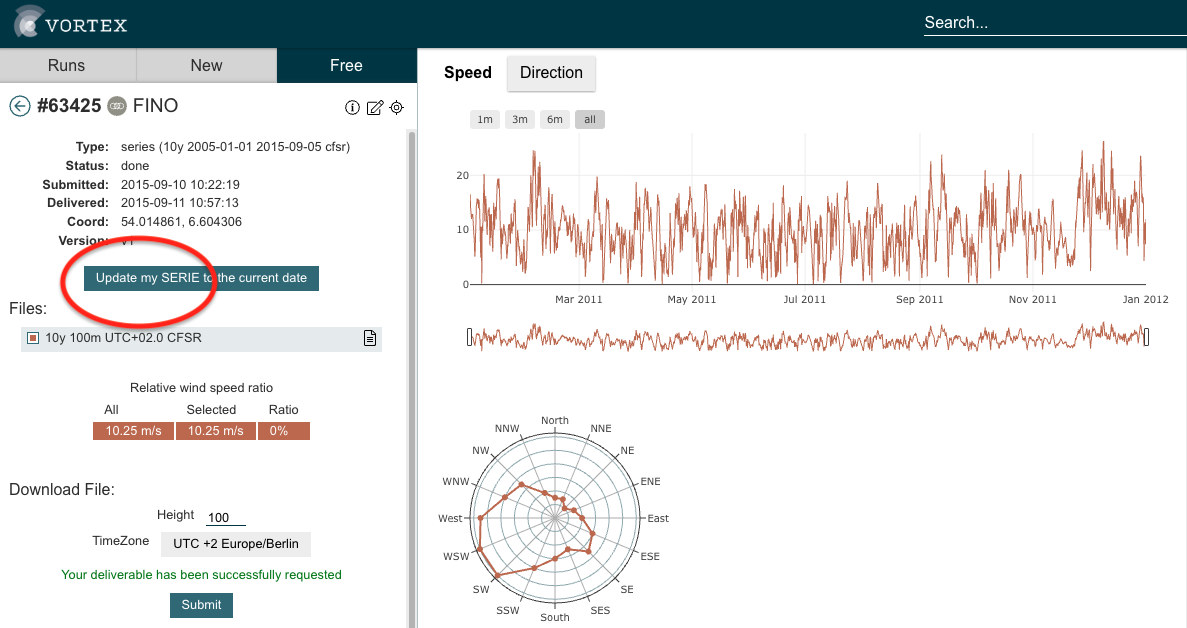
To keep the process straightforward, Vortex allows users to update any long-term time series (10-, 20-, or 30-year) free of charge once every 30 days. After 30 days have passed since the last update, the Update button becomes active again in the interface. Any previously requested remodelled time series will be automatically included when the Update button is clicked.
How long does an update take?
Need an update before 30 days have elapsed? Simply contact the Vortex support team (support@vortexfdc.com) — we can manually trigger the update for you.
The Climate Forecast System Reanalysis (CFSR) is produced by the National Centers for Environmental Prediction (NCEP), part of NOAA. CFSR data is updated daily with approximately a one-day lag. Vortex processes these updates immediately, so CFSR-based time series are available with that same one-day delay.
Practical example: On the 1st of a new month, users can update their series and receive complete data for the previous month.
The Modern-Era Retrospective Analysis for Research and Applications, Version 2 (MERRA2) is produced by NASA’s Global Modeling and Assimilation Office (GMAO). Unlike CFSR, MERRA2 is not updated daily. NASA typically releases a complete month of data between the 20th and 25th of the following month, creating an effective delay of more than 50 days.
Practical example: Complete data for January is generally available around the beginning of March.
The ERA5 reanalysis is produced by the European Centre for Medium-Range Weather Forecasts (ECMWF) through the Copernicus Climate Change Service (C3S). ERA5 data is generally available with a five-day delay. However, due to its higher spatial and temporal resolution, Vortex requires approximately two additional days to process and integrate new files — resulting in an overall delay of about eight days.
Practical example: Users can typically obtain complete data for the previous month around the 8th of the following month.
| Dataset | Institution | Typical Delay | Full Previous Month Available |
|---|---|---|---|
| CFSR | NCEP / NOAA | 1 day | 1st of the following month |
| MERRA2 | NASA / GMAO | ~50 days | 1st of the second following month |
| ERA5 | ECMWF / C3S | ~8 days | 8th of the following month |
Understanding these publication schedules helps you plan your analyses and ensure you’re always working with the most current data available. Whether you’re running a wind resource assessment or validating energy production estimates, knowing when your CFSR, MERRA2, or ERA5 data will be refreshed saves time and avoids surprises.
If you have questions about a specific time series or need an update before the 30-day window has elapsed, contact the Vortex support team.
Yes. Any remodeled time series previously requested will be automatically included when you click the Update button — no need to resubmit them manually.
CFSR is updated daily with just a one-day delay, making it the most current of the three. ERA5 follows with an ~8-day delay, while MERRA2 has the longest lag at approximately 50 days.
The Update button becomes available automatically every 30 days. If you need an earlier update for operational or project reasons, contact the Vortex support team — we can trigger it manually at no extra charge.
Modeled wind resource data for the wind industry.
At any site around the world. Onshore and offshore.